Access vs. Adoption: Canada’s AI Problem

AI is already becoming an everyday tool for Canadian business leaders. The harder challenge is turning individual experimentation into organizational productivity.
There is a curious contradiction emerging in Canada's artificial-intelligence economy.
More than two-thirds of business leaders surveyed by the Bank of Canada say they personally use AI tools during a typical workweek. Yet only 8 percent of surveyed businesses report significant use of AI in their core operations. Another 50 percent report low or moderate use, while 28 percent are neither using AI nor planning to adopt it in 2026.
Statistics Canada has found a similar pattern. In 2025, 12.2 percent of Canadian businesses reported using AI to produce goods or deliver services, twice the proportion recorded a year earlier. Adoption is growing quickly, but remains far from ubiquitous.
This gap matters because using an AI chatbot to draft an email is not the same thing as reorganizing a company around new technological capabilities.
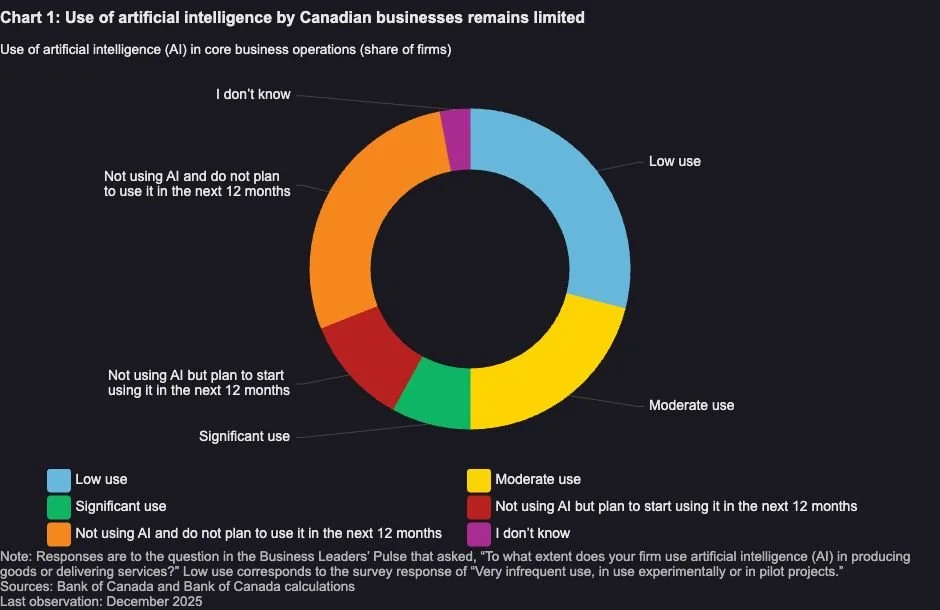
Figure 1. AI adoption in Canadian businesses. Among businesses surveyed by the Bank of Canada, 8% reported significant AI use in core operations, 21 % reported moderate use, 29% reported low use, 11% planned to begin using AI in 2026, and 28% reported neither using AI nor planning to adopt it in 2026.
Source: Chawla, Chanya, and Crystal Arnburg, “Canadian Businesses' Use of AI: What the Evidence Shows,” Bank of Canada, August 2026. Chart reproduced from the Bank of Canada.
For a growing share of Canadian businesses, the more consequential constraint may therefore no longer be access to AI itself. It is whether organizations possess the skills, infrastructure, data, management capacity and governance required to use it productively.
Using AI is Not the Same as Adopting It
The distinction between individual use and organizational adoption is economically important.
An employee might use generative AI to summarize documents, draft correspondence, or analyze information. These applications can save time. But the Bank of Canada distinguishes this kind of individual use from deeper adoption across business operations, where AI begins to influence production processes, capital investment and employment decisions.
That distinction helps explain why widespread experimentation has not yet produced an obvious economy-wide productivity revolution. Canadian businesses may have acquired the tool without yet changing the organization.
There is historical precedent for this. Economists studying general-purpose technologies have long observed that transformative technologies do not produce their full economic value simply by appearing. Their benefits depend on complementary investments in new processes, skills, products and business models. Research by Erik Brynjolfsson, Daniel Rock and Chad Syverson describes this as a "Productivity J-Curve": organizations may spend years building the intangible capabilities around a new technology before the resulting productivity gains become fully visible.
AI may require a similar period of organizational adaptation. The missing ingredient is complementary capability.
Recent Canadian evidence makes this particularly clear.
Statistics Canada researchers found that firms adopting AI initially appeared to have labour productivity 16.8 percent higher than non-adopters. But much of that apparent premium diminished once researchers accounted for differences between firms and their complementary capabilities.
The most productive firms may not simply be productive because they bought AI. Firms capable of adopting AI successfully are also more likely to possess other characteristics associated with innovation and digital transformation. The Statistics Canada research identified R&D, cloud computing, data analytics, advanced robotics and ICT training as significant predictors of AI adoption.
Consider a medium-sized company that purchases generative-AI licences for its employees. Access alone tells us very little about whether the investment will create economic value. The company still needs to identify which workflows should change, determine whether internal data can be used safely, train employees to evaluate unreliable outputs, and establish a way to measure whether AI is actually improving productivity.
It may also need to integrate AI with existing systems, establish rules around confidential information and decide who remains accountable when an AI-assisted process goes wrong.
Without these capabilities, AI risks becoming another layer of individual experimentation sitting on top of largely unchanged organizations. That can still produce useful efficiencies, but transformation requires considerably more.
Statistics Canada's own survey data suggest that businesses understand at least part of this challenge. Among firms planning to adopt AI, 49.8 percent expected to train existing employees, 41.9 percent expected to develop new workflows, 27 percent anticipated purchasing cloud services or storage, and 25.6 percent expected to change their data-management practices.
Those investments are not peripheral to AI adoption - they are part of it.
Canada's Adoption Gap is Uneven
The difficulty is that firms do not begin this transition from the same position.
Bank of Canada research finds that smaller businesses are less likely than larger businesses to use AI, reflecting a familiar pattern in the diffusion of new technologies: smaller firms generally have fewer resources available for experimentation and implementation.
The OECD has identified a similar problem internationally. Its research on AI adoption among small and medium-sized enterprises found persistent barriers involving skills, financing, data and digital infrastructure. In a 2025 survey, half of Canadian SMEs surveyed reported a lack of knowledge about how to use generative AI as a barrier to adoption.
A strategy centred on frontier models, research and compute capacity strengthens the supply side of the AI economy. Those investments are important, but they do not necessarily solve the diffusion problem facing an ordinary manufacturer, retailer or professional-services firm.
For these businesses, the constraint may instead be uncertainty about where AI creates value, weak digital infrastructure, shortages of relevant skills, implementation costs, or concerns about cybersecurity and privacy.
Not every company needs AI. Statistics Canada found that most businesses not planning to adopt it simply considered the technology irrelevant to their goods or services. That may be an entirely rational assessment.
The more interesting policy question is whether firms are equipped to make that assessment well.
Adoption Without Governance Creates Another Problem
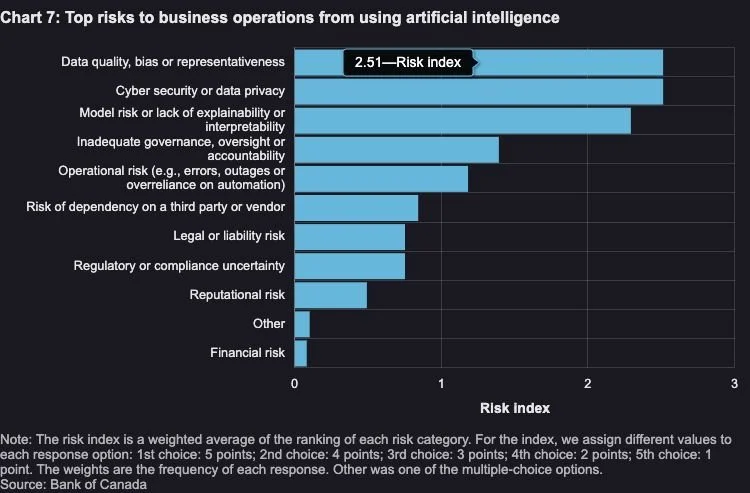
Figure 2. Operational risks associated with AI use. Financial-sector respondents identified a range of risks associated with AI, including data quality and bias, cybersecurity and data privacy, and model risk.
Source: Bank of Canada, Financial System Survey Highlights - 2026 (2026). Reproduced from the original.
Encouraging businesses to adopt AI without simultaneously developing the capacity to govern it creates a different kind of risk.
The Bank of Canada's 2026 Financial System Survey illustrates the problem particularly well. Nearly all participating financial-sector organizations reported some AI use, but most described it as limited or moderate. When asked about expanding adoption, 58 percent cited difficulty integrating AI into existing infrastructure and workflows, 56 percent reported talent constraints, 33 percent identified data-security and privacy concerns, and 31 percent cited implementation costs.
Respondents also identified model risk, cybersecurity, data privacy, third-party concentration and operational resilience among the risks associated with greater AI use. Many reported that governance maturity, skills shortages and AI-literacy gaps were limiting their ability to manage those risks.
This becomes increasingly important as organizations move from relatively low-risk applications such as summarization toward AI embedded in operational processes and decisions. A poorly written AI-generated email is inconvenient. A vulnerable AI integration, compromised dataset, unreliable automated process or excessive dependence on a handful of external AI providers can become an organizational risk.
The goal, then, should not be maximum adoption. It should be productive, secure and governable adoption.
That requires treating AI implementation as organizational change rather than software procurement. Technology teams, cybersecurity and privacy professionals, operational managers, legal functions and employees all have roles to play.
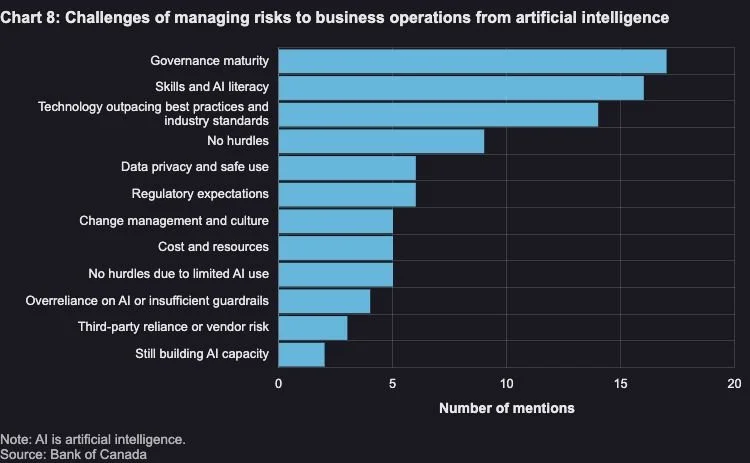
Figure 3. Challenges in managing AI-related operational risks. The Bank of Canada's 2026 Financial System Survey highlights organizational constraints affecting firms' ability to manage risks associated with greater AI adoption.
Source: Bank of Canada, Financial System Survey Highlights - 2026 (2026). Reproduced from the original.
Canada Needs a Diffusion Strategy
Canada's longstanding productivity challenge gives this issue greater urgency.
The Bank of Canada's 2026 assessment estimates that, under its baseline assumptions, AI could raise Canadian total factor productivity by approximately two percentage points cumulatively over ten years, or around 0.2 percentage points annually.
That is economically meaningful. But it describes a gradual diffusion process, not an overnight productivity revolution.
Canada has invested heavily in AI research and infrastructure. The next stage requires greater attention to the organizations expected to turn technological capability into economic output.
A serious diffusion strategy should address at least three problems:
The first is knowledge. Businesses need a better understanding of where AI is genuinely useful. Sector-specific demonstration projects, practical advisory services and stronger management education can help firms distinguish valuable applications from technology adopted for its own sake.
The second is capability. Firms need workers who understand the technology, usable data, appropriate cloud and digital infrastructure, and the organizational capacity to redesign workflows around it. The evidence from Statistics Canada suggests these complementary capabilities are closely connected to whether firms adopt AI in the first place.
The third is risk. Smaller organizations in particular may struggle to build sophisticated AI governance, privacy and cybersecurity functions internally. Practical guidance on secure implementation, data governance, procurement and third-party risk could therefore be as important to diffusion as encouraging businesses to experiment with AI.
The private sector has an equally important role. Companies should stop measuring AI adoption by the number of employees with access to a chatbot and start asking whether the technology has measurably changed how work is performed. This means measuring outcomes rather than licences. Capability will determine what comes next
Canada is clearly moving beyond the first stage of AI adoption. Business leaders are experimenting with the technology, firms are beginning to change workflows, and investment is expected to deepen. The Bank of Canada reports that nearly 40 percent of surveyed businesses expect AI to increase their capital spending over the next three years.
The harder stage is now beginning.
AI has to move from the individual employee's browser into organizational processes without introducing risks that outweigh the productivity gains. That requires management capacity, workforce skills, digital infrastructure, cybersecurity, data governance and a willingness to redesign established ways of working.
For Canada, this suggests that the next phase of AI policy should be judged not simply by how much technology the country can produce or how many people use it, but by how effectively Canadian organizations can absorb it.
Access made AI ubiquitous. Capability will determine whether it becomes economically transformative.
References
Bank of Canada. Financial System Survey Highlights - 2026. May 2026.
Bryan, Valerie, Shivani Sood, and Chris Johnston. “Analysis on Expected Use of Artificial Intelligence by Businesses in Canada, Third Quarter of 2025.” Statistics Canada, 2025.
Brynjolfsson, Erik, Daniel Rock, and Chad Syverson. “The Productivity J-Curve: How Intangibles Complement General Purpose Technologies.” American Economic Journal: Macroeconomics 13, no. 1 (2021): 333–372.
Chawla, Chanya, and Crystal Arnburg. “Canadian Businesses' Use of AI: What the Evidence Shows.” Bank of Canada, August 2026.
Chernoff, Alex, Christopher Hajzler, Stéphanie Houle, Gabriella Ruggero, Olena Senyuta, Karanbir Sohal, Walter Steingress, and Temel Taskin. Potential Output in Canada: 2026 Assessment. Staff Analytical Paper 2026-19. Bank of Canada, May 2026.
Li, Jiang, and Huju Liu. “Artificial Intelligence Adoption and Productivity in Canadian Firms.” Economic and Social Reports. Statistics Canada, April 2026.
Header image: Patrick Tomasso.
