The Missing Rung: AI Reshaping Entry-Level Work in Canada
Artificial intelligence may transform the labour market without producing mass layoffs. The earlier warning may be a quieter one: fewer opportunities to get in.
For years, the debate over artificial intelligence and employment has centred on a dramatic question: which jobs will disappear?
Canada's emerging labour-market evidence points to a subtler possibility. AI may begin changing employment not by pushing established workers out of their jobs, but by making it harder for new workers to enter them.
Recent Bank of Canada analysis found little evidence of higher job separation in occupations most exposed to AI. Instead, the more striking change has occurred in hiring. Compared with workers in occupations with low AI exposure, unemployed Canadians seeking work in highly exposed occupations have become considerably less likely to find it. The Bank describes the findings as early signals rather than evidence that AI caused the change. But the distinction between hiring and layoffs deserves attention.
If AI allows organizations to automate the routine work traditionally assigned to junior employees, Canada's challenge may not initially be mass technological unemployment. It may be the erosion of the first rung of the career ladder.
The Labour Market is Sending an Unusual Signal
The Bank's analysis divides occupations according to how exposed their tasks are to current AI capabilities. Data entry clerks, receptionists, accounting clerks, financial clerks, customer-service representatives and office-support workers rank among the most exposed because their work contains relatively large amounts of routine, codifiable information processing.
The researchers then compared labour-market outcomes in occupations with different levels of AI exposure.
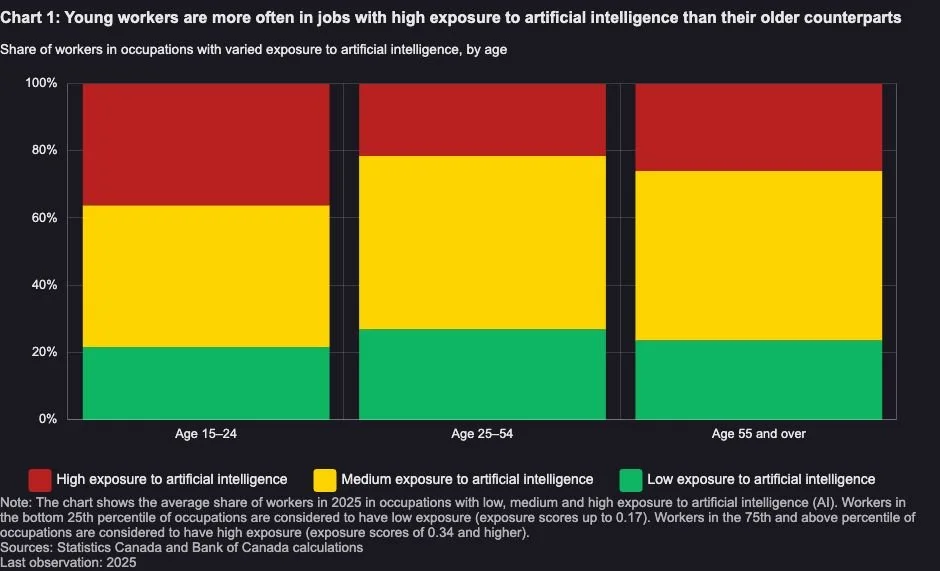
Figure 1. The deterioration associated with AI exposure appears primarily in hiring rather than job separation. Between 2015–19 and 2025, the estimated job-finding-rate gap between fully AI-exposed and unexposed occupations widened substantially, while the job-separation gap changed little.
Source: Bank of Canada calculations using Statistics Canada Labour Force Survey data and occupational AI-exposure estimates. Bank of Canada (2026), Early signs of AI-driven adjustments in Canada's labour market.
Between the 2015–19 period and 2025, the estimated gap in job-finding rates between fully AI-exposed and unexposed occupations deteriorated by 11.7 percentage points. The corresponding change in job-separation rates was just 0.1 percentage points. If AI were already producing widespread displacement, we might expect workers in highly exposed occupations to be losing jobs at markedly higher rates. The Bank does not find that pattern. Instead, the emerging pressure appears concentrated among people trying to find work.
Governor Tiff Macklem raised a related concern earlier this year, noting both weaker job-finding outcomes in AI-exposed occupations and a declining share of entry-level vacancies.
None of this proves that AI is responsible. Canada's labour market has absorbed the effects of the pandemic, rapid population changes, trade disruption and weaker hiring. The Bank explicitly cautions against attributing post-2019 changes to AI alone.
The OECD reaches a similarly careful conclusion: labour-market conditions have deteriorated for young people across advanced economies, but current evidence does not establish AI as the cause.
The warning signal is nonetheless important because of where AI is capable of substituting for human effort. Entry-level work has an economic function beyond output. Entry-level employees are rarely hired because they are the organization's most productive workers. They are hired partly because organizations need a pipeline through which inexperienced people become experienced ones.
A junior analyst researches, summarizes documents, prepares first drafts and cleans data. A new accountant reconciles records and performs routine analysis. A junior communications employee drafts basic material. A young lawyer reviews documents. An administrative employee processes information and coordinates routine tasks.
These activities not only create output, but also workers.
Through relatively structured work, employees learn how organizations operate, observe senior colleagues, make low-consequence mistakes, develop professional judgment and gradually take responsibility for more complex decisions.
Generative AI is particularly capable of assisting with many of these tasks because they involve information retrieval, classification, summarization, drafting and routine analysis. The technology does not need to replace an entire occupation to alter the economics of hiring its most junior members.
Imagine a ten-person analytical team that previously required three junior employees. If AI allows the seven experienced employees to absorb enough drafting, research and routine analysis that the team now requires only one junior employee, nobody has been "replaced." There may be no layoff to measure. But two entry points have disappeared.
Repeated across thousands of organizations, that change could alter how careers begin without producing the sudden wave of technological unemployment that dominates public debate.
Young Canadians are Already Entering a Weaker Market
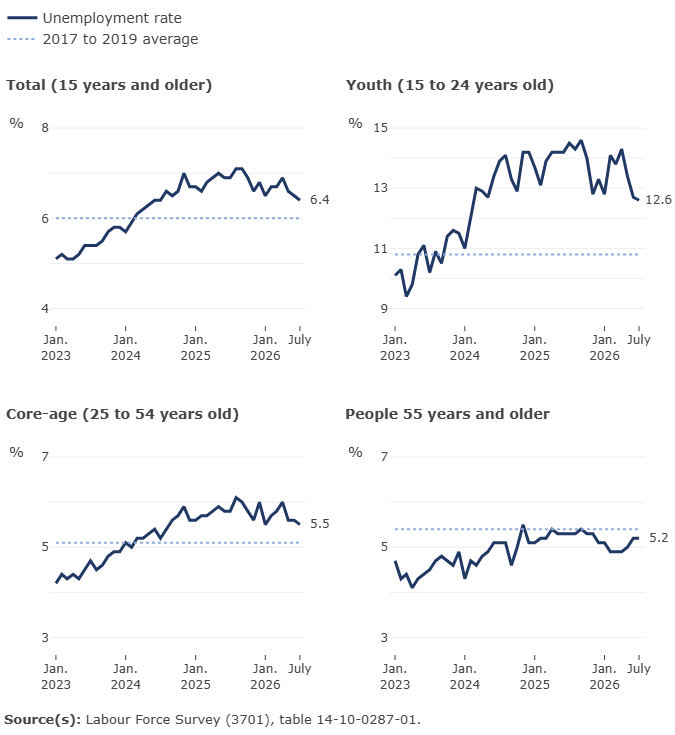
Figure 2. Canada's youth unemployment rate has eased from its recent peak but remains above its pre-pandemic average. In July 2026, unemployment among people aged 15–24 stood at 12.6 per cent, compared with an average of 10.8 per cent from 2017 to 2019.
Source: Statistics Canada, Labour Force Survey, July 2026, Table 14-10-0287-01.
This risk arrives at a difficult time.
Statistics Canada reported a youth unemployment rate of 12.6 per cent in July 2026. That is an improvement from the recent peak, but remains above the 10.8 per cent pre-pandemic average.
The broader Canadian labour market has also become less favourable to entrants. The OECD reports that there were only 0.3 job vacancies for every unemployed person in the first quarter of 2026, compared with 0.5 immediately before the pandemic. Recent Canadian labour-market entrants face a larger unemployment disadvantage than established workers, including among graduates.
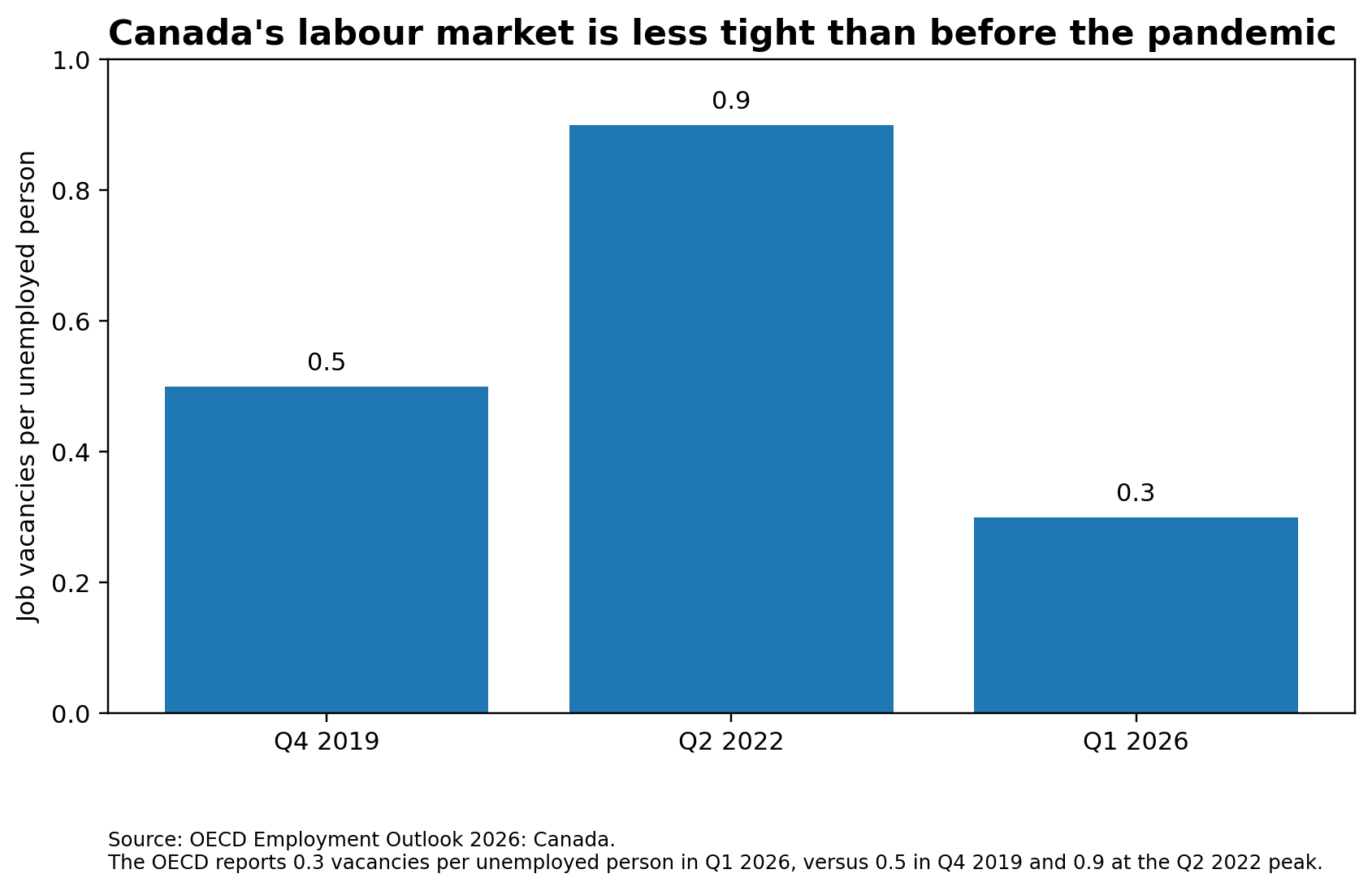
Figure 3. Canada's labour market has become substantially less tight. There were 0.3 job vacancies for every unemployed person in the first quarter of 2026, compared with 0.5 immediately before the pandemic and 0.9 at the 2022 peak.
Source: OECD, OECD Employment Outlook 2026: Canada.
Again, AI cannot simply be blamed for these conditions. But it is a factor to scrutinize.
A soft labour market gives employers less reason to take risks on inexperienced candidates. AI may simultaneously reduce the amount of routine work that once made those candidates economically useful.
Young workers could therefore face two pressures at once: cyclical weakness in hiring and structural change in the tasks associated with junior employment.
The Bank also finds that younger workers are disproportionately represented in occupations with moderate or high AI exposure, including customer service and sales support.
The policy question is no longer simply whether AI destroys jobs. It is whether technological adoption changes who gets an opportunity to acquire experience in the first place.
Employers Face a Pipeline Problem Too
Reducing junior hiring may appear rational for individual firms. It could become costly collectively.
Organizations cannot hire experienced workers forever without producing new ones.
Today's senior accountant was once assigned routine accounting work. Today's policy director once prepared briefing material. Today's senior lawyer once reviewed documents that software can increasingly process.
If organizations automate a large share of developmental work without redesigning how employees acquire the knowledge embedded in it, they risk weakening their own future talent pipelines.
The problem is especially acute where professional judgment depends on accumulated experience.
AI can produce a competent first draft. But learning to recognize when that draft is misleading requires expertise. If junior employees increasingly receive finished outputs rather than performing the underlying work, employers will need other mechanisms for developing that expertise.
The central management question should therefore not be, “Which junior tasks can we automate?” It should be, “Which tasks can we automate without eliminating the process through which people learn to perform the senior ones?”
Canada's Policy Response Should Focus on Career Formation
Governments should also distinguish displacement from entry.
Traditional labour-market responses to technological change concentrate on workers who lose jobs: retraining, income support and transitions into growing sectors. Those policies matter, but they address a different problem.
A graduate who cannot obtain a first professional job does not need conventional retraining. She may already have spent years acquiring formal qualifications. What she lacks is the opportunity to convert education into experience.
Governments should track entry-level vacancies and job-finding rates in AI-exposed occupations rather than relying primarily on aggregate employment figures. Universities and colleges should examine whether programs built around a conventional education-to-junior-job pipeline remain adequate. Work-integrated learning, apprenticeships, co-ops and structured graduate programs may become more important if employers become less willing to bear the cost of training inexperienced workers.
Employers adopting AI should be encouraged to redesign junior roles rather than simply remove them. If software performs more first drafts and routine processing, new employees can be trained earlier in verification, client interaction, judgment, systems thinking and the supervision of AI-generated work.
The objective should not be to preserve obsolete tasks for their own sake. Economies become richer by finding more productive ways to perform work.
The objective is to preserve the development of human capability even when the tasks that once developed it become automated.
Watch the Doorway
AI may ultimately create new occupations, increase productivity and expand demand for forms of work that are difficult to predict today. Canada's current evidence is far too preliminary to conclude otherwise.But policymakers and employers should stop looking only for disappearing jobs.
Technological change can reshape a labour market long before it produces mass layoffs. If firms retain experienced employees while quietly hiring fewer inexperienced ones, aggregate employment statistics may initially conceal the transformation.
The first major labour-market consequence of generative AI may not be workers losing their jobs, but a generation finding it harder to get its first one.
References
Bank of Canada. (2026a). Early signs of AI-driven adjustments in Canada's labour market. Sparks at Bank, August 2026.
Bank of Canada. (2026b). Structural change—Canada at a crossroads. Remarks by Governor Tiff Macklem, February 5, 2026.
OECD. (2026a). OECD Employment Outlook 2026: Canada. OECD Publishing, July 7, 2026.
OECD. (2026b). Young people, labour markets and AI: What OECD evidence shows. August 15, 2026.
Statistics Canada. (2026a). Canadian employment trends in the era of generative artificial intelligence: Early evidence. Economic and Social Reports, January 28, 2026.
Statistics Canada. (2026b). Labour Force Survey, July 2026. The Daily, August 7, 2026.
Thumnail photo: the blowup on Unsplash.
