Beyond AI Labels: Canada Needs an Accountability Framework for Autonomous Agents
Artificial intelligence is beginning to do more than generate information. As AI systems gain the ability to send emails, make purchases, issue refunds and interact with other digital systems, Canada will need to decide what accountability means when software begins acting on our behalf.
The federal government is currently asking Canadians what AI transparency should look like.
Its new consultation covers familiar questions: how to identify AI-generated content, when people should be told they are interacting with AI, what information companies should disclose about their systems and how serious AI incidents should be reported.
But one part of the consultation raises a more difficult problem: AI systems are beginning to act.
Consumer-facing chatbots are acquiring agentic capabilities that allow them to perform tasks on behalf of users. An AI agent might book a meeting, send an email, purchase a product, process a refund or interact with another software system without requiring human approval at every step. This changes the transparency problem considerably.
Knowing that something was generated by AI is useful. Knowing what an autonomous system actually did, who authorized it, what information it accessed and whether its actions can be reversed may soon matter much more.
Canada's emerging challenge is therefore not simply AI disclosure. It is AI accountability.
Transparency Becomes Harder When AI Can Act
The distinction between a chatbot and an AI agent may appear technical, but it has significant governance implications.
A conventional chatbot produces an output. A user asks a question and receives an answer. If the answer is wrong, the consequences depend largely on what the user chooses to do with it.
An agent can move one step further. It can be given access to tools, accounts, databases and other systems and instructed to complete a task.
The federal discussion paper offers a simple example: a consumer instructs an agent to automatically repurchase a household product each month. The agent misinterprets the instruction and purchases twelve packages instead of one package containing twelve items.
Now several questions arise.
Who authorized the transaction? What instruction did the user actually give? What permissions did the agent possess? Which system made the error? Can the transaction be reversed? And if the agent interacted with other agents or services along the way, which actor is responsible?
These questions become substantially more consequential when the transaction involves something more important than household supplies. This is pertinent for agents processing insurance claims, handling procurement, managing customer accounts, accessing internal corporate systems or carrying out administrative tasks within government.
The same capabilities that make agents economically useful also make their failures more consequential.
When AI Acts for You, Someone Needs the Receipts
This is why the most important concept in Canada's consultation may ultimately be auditability.
ISED notes that organizations are already adopting tools that record what AI agents do: which tools they invoke, what actions they take, how they interact with other systems and, where possible, the decision pathways behind those actions. The discussion paper also points to emerging work on activity logs, identity credentials and agent observability.
These mechanisms are important because accountability becomes difficult when there is no reliable record of events.
Traditional digital systems already generate logs for similar reasons. Cybersecurity teams use them to reconstruct incidents. Financial institutions maintain transaction records. Administrative systems preserve audit trails. Access-management systems record who entered a system and what privileges they exercised.
Agentic AI creates a related problem, except the actor may now be software operating under delegated human authority.
A useful accountability framework should therefore be able to answer several basic questions after an important agent action:
Which agent acted?
On whose authority?
What was it authorized to do?
What systems and information did it access?
What action did it take, and when?
Was human approval required or obtained?
Can the action be challenged or reversed?
The principle is relatively simple: the greater an agent's autonomy and the more consequential its permissions, the stronger the case for a reliable audit trail.
Logging Everything Creates Another Risk
The obvious response would be to require extensive records of agent activity. But this would solve one problem while potentially creating another.
An agent capable of acting meaningfully on someone's behalf may have access to unusually sensitive information: emails, financial accounts, calendars, customer records, internal documents, authentication credentials or corporate databases.
Detailed logs of everything an agent sees and does could themselves become highly sensitive datasets.
A record designed to establish accountability after an incident might reveal personal information, commercially confidential material or security-sensitive details about an organization's systems.
Retaining those records indefinitely would increase the consequences of a breach.
The policy problem is therefore not simply whether agents should be logged. It is deciding what should be recorded, for how long, who should be able to access those records and how securely they should be stored.
This is where AI transparency intersects directly with cybersecurity and privacy. Too little logging can make investigation, redress and liability difficult. Too much logging can create a new concentration of sensitive information worth attacking.
Canada should avoid treating transparency as synonymous with collecting as much information as possible.
The objective should be proportionate traceability.
Not Every Agent Needs the Same Rules
A useful Canadian framework should also distinguish between levels of consequence.
An agent that reorganizes someone's calendar does not create the same risk as one authorized to transfer money, modify a production database or make decisions affecting access to an essential service.
The appropriate level of oversight should therefore depend partly on what an agent is capable of doing.
For relatively low-risk tasks, basic disclosure and activity records may be sufficient.
As autonomy, access and potential consequences increase, stronger requirements become easier to justify: explicit permission boundaries, stronger identity and authorization controls, human approval at critical points, secure logs and mechanisms for contesting or reversing actions.
This risk-based approach would also reduce the danger of imposing expensive compliance requirements on every organization experimenting with agentic AI.
Small and medium-sized businesses will not have the governance teams of major banks or technology companies. The federal consultation explicitly asks how future measures should account for their circumstances. A framework so burdensome that only large organizations can comply with it could discourage useful adoption without necessarily improving safety.
Canada Does Not Need to Start From Scratch
Other jurisdictions are already moving in this direction.
Singapore's Model AI Governance Framework for Agentic AI, introduced in 2026 and subsequently updated with implementation guidance and case studies, recommends that organizations limit agent autonomy and access to tools and data, establish meaningful human accountability, implement technical controls throughout the agent lifecycle and maintain appropriate monitoring.
In the United States, the National Institute of Standards and Technology has begun examining another foundational problem: how software and AI agents should establish identity and authority when accessing digital resources.
That work points toward a broader principle.
If AI agents are going to participate in digital environments as increasingly autonomous actors, systems need reliable ways to determine not merely that an agent exists, but which agent it is and what it has permission to do.
Canada should pay close attention to these developments rather than designing agent governance as an isolated domestic exercise.
Interoperability will matter. Canadian businesses operate across borders, use foreign AI systems and depend on global cloud and software providers. An accountability regime built around incompatible technical requirements could quickly become difficult to implement.
The Timing Matters Because Adoption is Accelerating
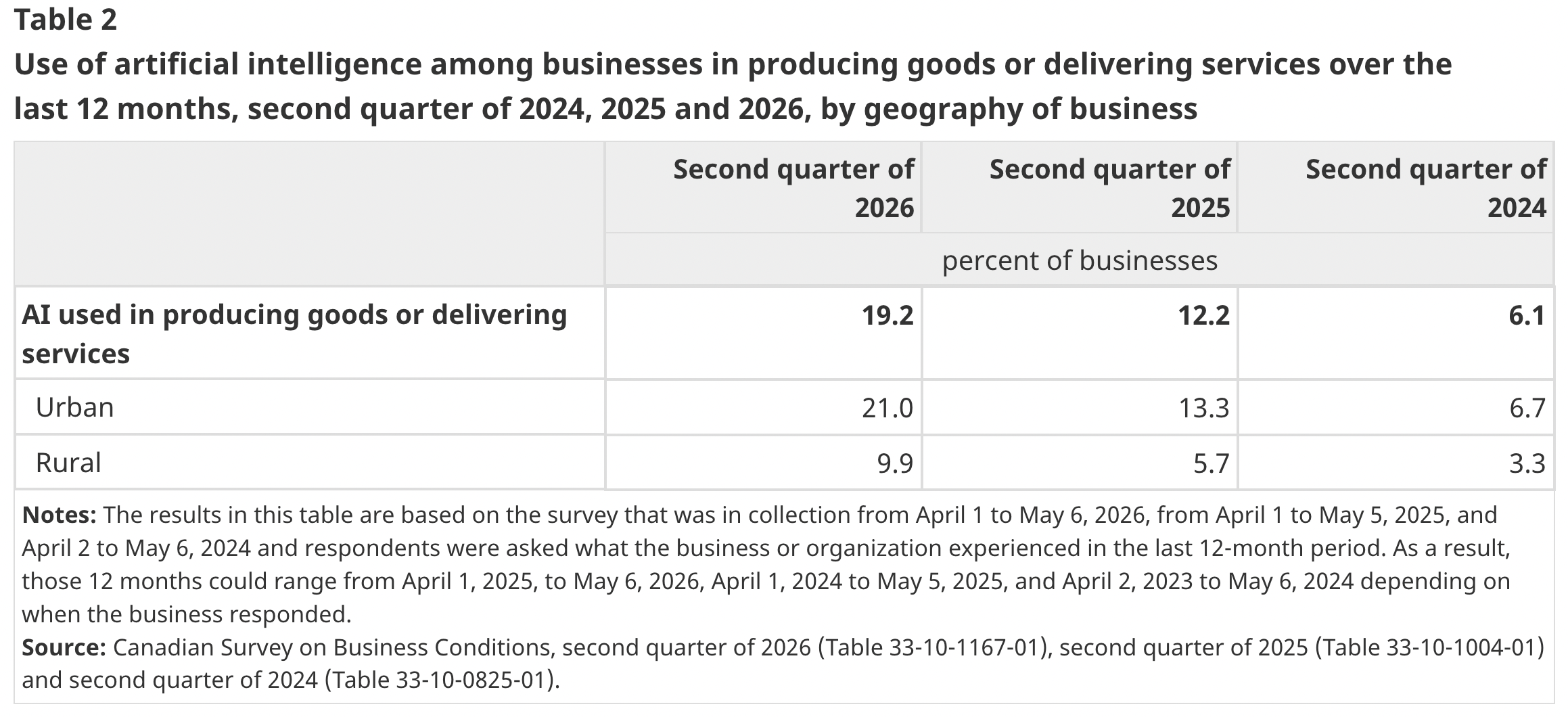
Figure 1. AI use among Canadian businesses has increased sharply since 2024. The share of businesses reporting that they used artificial intelligence to produce goods or deliver services increased from 6.1 percent in the second quarter of 2024 to 19.2 percent in the second quarter of 2026. AI use remains substantially higher among urban businesses than rural businesses.
Source: Statistics Canada, Analysis on Artificial Intelligence Use by Businesses in Canada, Second Quarter of 2026, Canadian Survey on Business Conditions, Table 2, June 2026.
This discussion might seem premature if autonomous agents were still confined to research laboratories. However, they are not.
Statistics Canada reported that 19.2 percent of Canadian businesses used AI to produce goods or deliver services in the second quarter of 2026, up from 12.2 percent a year earlier and 6.1 percent in 2024.
Among businesses already using AI, 28.2 percent reported using virtual agents or chatbots. The share using AI-based decision-making systems also rose sharply, from 5.7 percent in 2025 to 13.7 percent in 2026.
These figures do not measure autonomous-agent deployment specifically, and they should not be interpreted as doing so. But they show how quickly AI is moving into Canadian business operations.
Governance is easier to design before practices become deeply embedded.
Canada has an opportunity to establish expectations around agent identity, authorization, oversight and traceability while deployment is still relatively early.
From Transparency to Accountability
The federal government is right to begin with transparency.
People should know when they are interacting with AI. Organizations procuring AI systems need meaningful information about their capabilities and limitations. Serious incidents need mechanisms through which they can become visible to regulators and policymakers.
But autonomous agents expose the limits of disclosure alone. A label can tell someone that AI is present. It cannot tell them what the AI subsequently did.
As agents acquire greater authority to interact with businesses, governments and digital infrastructure, Canada will need a framework capable of reconstructing those actions when something goes wrong.
That does not necessarily require an entirely new regulatory regime. Existing privacy, consumer-protection, cybersecurity, financial and sector-specific rules will continue to matter. Industry standards and technical solutions may resolve some problems without legislation.
The government's own consultation appropriately leaves that question open.
But whatever framework emerges should preserve a basic principle: delegating an action to software should not make responsibility for that action impossible to trace.
For high-consequence agentic systems, Canada should be moving toward proportionate requirements around identity, authorization, human oversight, secure activity records and avenues for redress.
The goal is not to record every thought an AI system produces. It is to make consequential digital actions attributable enough that organizations, regulators and individuals can determine what happened when it matters.
References
Do, Vicky, Shivani Sood, and Chris Johnston. “Analysis on Artificial Intelligence Use by Businesses in Canada, Second Quarter of 2026.” Statistics Canada, June 2026.
Government of Canada. “Government of Canada Launches Public Consultation on AI Transparency.” Innovation, Science and Economic Development Canada, July 23, 2026.
Innovation, Science and Economic Development Canada. Enhancing Trust in Artificial Intelligence Through Increased Transparency. Government of Canada, 2026.
Infocomm Media Development Authority. Model AI Governance Framework for Agentic AI. Government of Singapore, updated May 2026.
National Institute of Standards and Technology. Accelerating the Adoption of Software and Artificial Intelligence Agent Identity and Authorization. National Cybersecurity Center of Excellence, February 2026.
Title photo by Luke Jones on Unsplash.
